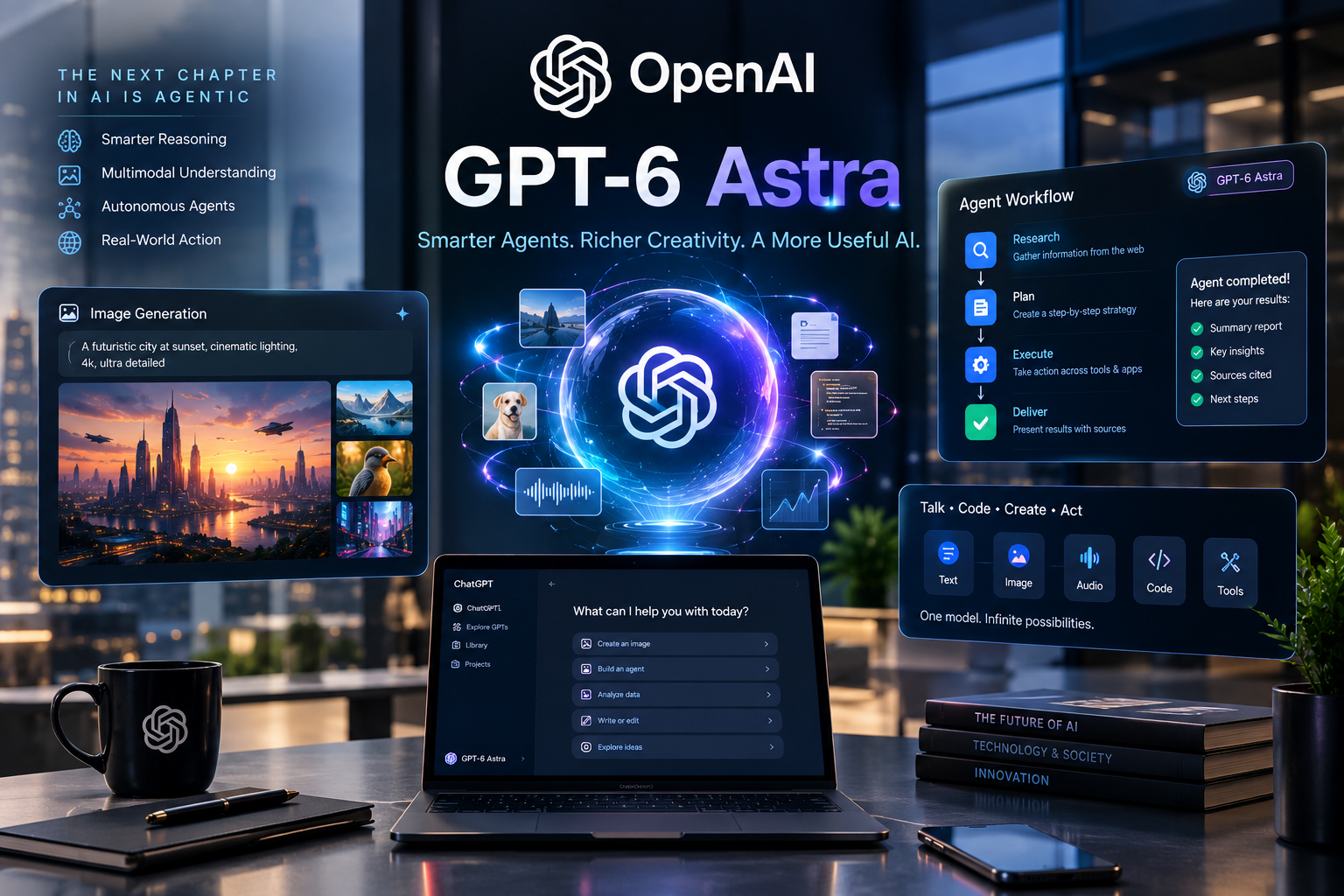

OpenAI News is moving quickly in September 2026, with several major announcements arriving within days of one another. The company has introduced GPT-6 Astra, expanded developer access to long-running AI agents, launched ChatGPT Images 2.5, and added a tailored ChatGPT experience for financial services. OpenAI has also published a framework for reporting model misalignment. Together, these releases show a shift from AI chatbots toward systems that can reason, create, use tools, and operate inside professional workflows.
For readers following AI products and business technology, the key question is what each release changes for users and developers.
The biggest OpenAI News development: GPT-6 Astra
The headline release is GPT-6 Astra, introduced on September 3, 2026. OpenAI News describes it as a new generation of intelligence and says it is state-of-the-art in computer use, browsing, software engineering, cybersecurity, science, and professional work. The model is rolling out to organizations first, followed by ChatGPT Plus, Pro, Business, and Enterprise users, as well as access through the OpenAI API, Microsoft Azure, and Amazon Bedrock.
Astra is designed to do more than generate text. OpenAI News says it can handle tasks such as filling forms, updating CRM records, researching online, working with documents and spreadsheets, building websites, and running frontend quality checks.
OpenAI is also emphasizing safety alongside capability. Its safety overview says GPT-6 Astra reached the Critical level for cybersecurity capability under the company’s Preparedness Framework, leading to stronger protections around harmful cyber actions and internal deployment.
Agents API brings longer-running AI workflows
Another major OpenAI News story is the Agents API, released in public beta on September 10. OpenAI says the API gives developers access to the infrastructure used by Codex so agents can manage context, use tools, coordinate subagents, work with files, run code, and continue operating over long sessions.
This matters because AI development is moving beyond single prompts. An agent can carry out a sequence of tasks while using tools and retaining working context.
For developers, the practical appeal is less infrastructure to build themselves. OpenAI is packaging an environment for agentic applications while allowing developers to choose their application experience and agent environment. Because the API is still in public beta, teams should evaluate reliability, costs, permissions, and workflow fit before putting it at the center of production systems.
💡 Pro Tip: Test an AI agent on a complete workflow rather than a single impressive demo. Measure accuracy, tool use, recovery from errors, time saved, and how often a person must intervene.
ChatGPT Images 2.5 focuses on creation and editing
OpenAI’s September 8 release of ChatGPT Images 2.5 adds a stronger image-generation and editing layer. OpenAI says the model provides sharper details, more precise editing, faster generation, better reference-image consistency, and improved results across multiple editing turns. The company also says generation latency has been reduced by up to 50% compared with Images 2.0.
The update adds Sketch, templates, image comments, and prompt sharing. OpenAI News says Images 2.5 is available across desktop, mobile, and web for ChatGPT, ChatGPT Work, and Codex users.
For publishers, marketers, designers, and social teams, the change is workflow speed: creating an image, making targeted edits, and preserving important visual elements can happen in one environment.
OpenAI is targeting professional industries
September also brought a more specialized direction. On September 10, OpenAI announced ChatGPT for Financial Services, a tailored ChatGPT Work experience built around GPT-6 Astra and integrated financial data. OpenAI says the product is designed for research, financial modeling, and customized client materials, with data from providers including Daloopa, PitchBook, LSEG News, and Crunchbase.
The broader significance is that frontier models are being packaged for specific industries instead of being offered only as general assistants. Industry-specific data, governance, and workflow controls can matter as much as raw model capability when organizations decide whether to deploy AI.
This could become a defining theme in future OpenAI News coverage: general models remain important, but specialized products may increasingly shape how businesses use AI.
Transparency and model safety are part of the product story
OpenAI also published a model-misalignment reporting framework on September 16. The company says it will use the framework to track, investigate, and disclose qualifying examples of unexpected or concerning model behavior, and it released six reports covering observations from the previous six months. OpenAI says the process is intended to make disclosures more systematic and faster, including cases that are not yet fully explained or mitigated.
That matters because increasingly capable models create two parallel questions: what systems can do and how reliably they stay within intended boundaries. OpenAI’s framework acknowledges that alignment and monitoring remain unresolved research areas.
For users, capability claims should be considered alongside availability, safeguards, privacy controls, and the limits of current AI systems.
What these OpenAI News releases mean for everyday users
The recent OpenAI News cycle can be organized into four connected themes:
| Update | Main change | Who should watch it | Practical significance |
|---|---|---|---|
| GPT-6 Astra | Advanced reasoning and computer use | General users, professionals, developers | Handles more complex multi-step work |
| Agents API | Managed infrastructure for cloud agents | Developers and businesses | Makes long-running agent workflows easier to build |
| ChatGPT Images 2.5 | Faster, precise image creation and editing | Creators, marketers, publishers | Reduces friction in visual production |
| Financial Services | Industry-specific ChatGPT experience | Financial institutions | Combines AI with specialized data and controls |
📌 Key Takeaway: The latest OpenAI News releases show the company pushing AI from conversation toward execution. Models are increasingly expected to work with software, data, images, tools, and business processes rather than simply answer questions.
Frequently Asked Questions
What is the latest OpenAI News right now?
As of September 18, 2026, recent major announcements include GPT-6 Astra, the Agents API, ChatGPT Images 2.5, ChatGPT for Financial Services, and a framework for reporting model misalignment.
What is GPT-6 Astra?
GPT-6 Astra is OpenAI’s latest broadly deployed frontier model, with stronger capabilities in computer use, coding, browsing, science, and professional work. Availability is being rolled out across consumer, business, and API channels.
What does the Agents API do?
The Agents API is a public-beta interface for building cloud agents with OpenAI-managed infrastructure, including support for tools, files, code execution, long-running work, and subagents.
Is ChatGPT Images 2.5 available to users?
OpenAI says Images 2.5 is available across desktop, mobile, and web for ChatGPT, ChatGPT Work, and Codex users.
Why is OpenAI reporting model misalignment incidents?
OpenAI says the framework is intended to make disclosures of unexpected or concerning model behavior more systematic, helping researchers, developers, policymakers, and the public examine emerging safety issues.
Conclusion
The latest OpenAI News points to a company broadening its focus from chat-based AI toward systems that can execute multi-step work, generate and edit media, support specialized industries, and operate through developer platforms. GPT-6 Astra, the Agents API, Images 2.5, and the safety reporting framework each address a different part of that transition. For readers tracking AI, capability is expanding, but practical adoption still depends on access, reliability, safeguards, and task fit.